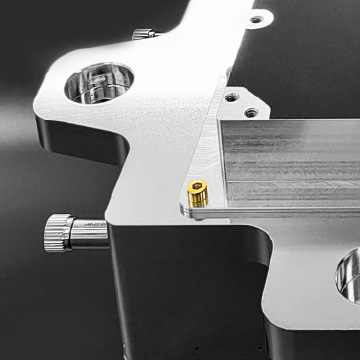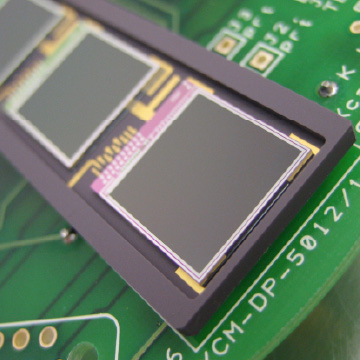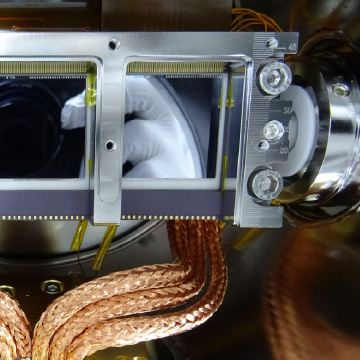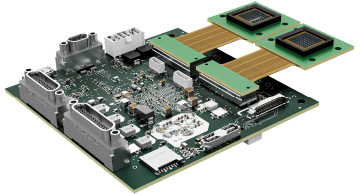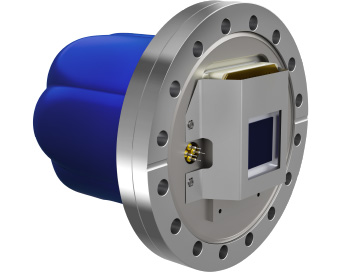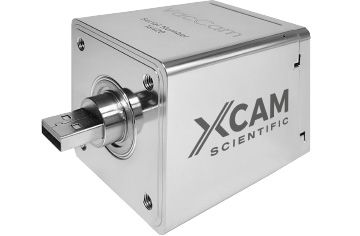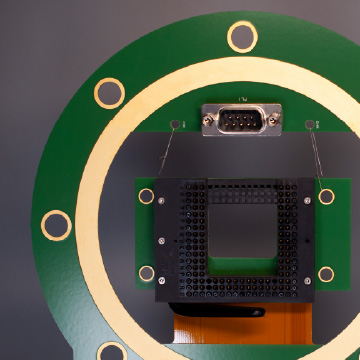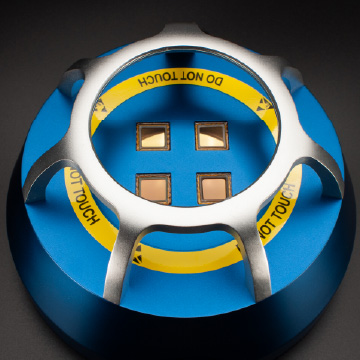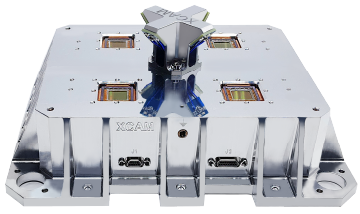



XCAM has been shortlisted for the ‘Insider Made in the Midlands’ 2016 award, in the advanced manufacture section, as a result of its development of a new camera system for high-end scientific applications. The RIXSCam™ has been developed in consultation with the researchers at one of the world’s leading science facilities, the Swiss Light Source and scientists at the Open University. The scientists who will use the camera system to study the structure of novel materials through their interactions with x-rays.
The project is another example of XCAM’s success in collaborative design to meet the demanding requirements of our customers and builds on our tradition of working with scientists to develop new solutions for challenging conditions. In addition to the growth of experience in the field, a new graduate has been taken on to complete an industrial PhD programme, which will be completed through studies undertaken at the Open University in the UK.
Drs Thorsten Schmitt and Bernd Schmitt from the Paul Scherrer Institute (PSI) have visited XCAM to witness testing of the new RIXSCam™ system. The system was developed by XCAM in consultation with the researchers to provide a tailor-made system for science on RIXS beamlines. The RIXSCam™ will be used in the world’s most advanced synchrotron light sources to investigate the electronic behaviour in condensed matter systems. The first system will be delivered to the PSI and commissioned at the ADRESS beamline of the Swiss Light Source in late spring this year.
The system is part of a wider series of advances to improve the resolution that can be achieved at RIXS beamlines. The RIXSCam™ design combines XCAM’s experience building for ultra-high vacuum conditions with post-processing of the captured image to achieve the highest sensitivity and resolution. The project is another example of XCAM’s success in collaborative design to meet the demanding requirements of our customers and builds on our tradition of working with scientists to develop new solutions for challenging conditions.
Established in 1995 as a spin-out of the space research centre at Leicester University, we initially focussed on developing control systems for CCD detectors. In 2003, we started to take on work designing and making complete camera systems in response to enquiries for systems that no one else was able to make. We now build detectors to be incorporated into larger systems and for a range of other applications.
XCAM’s reputation for innovation has been built up through working closely with our customers on their challenges, and on our extensive knowledge of detector science. We typically consult on specific applications of CCD technology with our customers and use our experience to design and build the complete system, including the electronics and the mechanical housing for the detector.
Continuously growing our team and capabilities, we never stop learning through our projects. If you have an unusual imaging or detection problem, why not talk to us about it today?
XCAM camera electronics has recently been launched into space on the UK Space Agency’s first Cube Satellite.
The camera, called C3D, was led by the Centre for Electronic Imaging (CEI) at the Open University. C3D houses three new CMOS sensors from e2v technologies into a design which will both take pictures of the earth and enable investigations of the impact of space radiation damage on the detectors. XCAM was responsible for the development and manufacture of the camera control electronics which uses state-of-the-art components, including a powerful FPGA to both control the CMOS sensors and to communicate with the main spacecraft computer.
Related news stories can be found below:
OU joins the Cubesat revolution
UK Space Agency announces successful launch for first cubesat mission
XCAM has been awarded a grant by Innovate UK, the UK’s innovation agency, to perform a feasibility study for an in-situ tritium monitor for use in bore-holes at nuclear sites. XCAM has already developed technology which enables digital images to be taken of samples containing tritium. This technology will be further developed during this feasibility trial, which will see the team putting a monitor down a bore-hole at the Sellafield site in conjunction with the Sellafield ground technical team. If the new technique is successful it will provide results much faster than is currently possible.
Feasibility Studies is a single-company or collaborative R&D grant scheme run by Innovate UK that allows businesses the opportunity to test an innovative idea and its feasibility to be developed and eventually taken to market. Feasibility studies are a way for companies to carry out exploratory studies which could lead to the development of new products, processes, models, experiences or services. The study could involve for instance investigating the technical feasibility of a new idea.
https://www.innovateuk.org/-/feasibility-studies
This contract, under a programme funded by the European Space Agency, will see the company developing a prototype particulates-monitor capable of monitoring the deposition and redistribution of 5 micron dust particles in real-time. This monitor will form a proof-of-concept prototype which may later be further developed for use inside rocket fairings for the monitoring of particulate contamination during and shortly after launch of space instruments. XCAM will also investigate the possibility of using this new technology in clean room environments.
News items are maintained by XCAM and do not reflect the official opinion of the European Space Agency.
XCAM was delighted to be awarded a second Invent grant to enable them to develop new production facilities in addition to a larger new stores area. Following on from this, we were even more pleased to be awarded an HPT grant worth £90,000; this was awarded to enable XCAM to do R+D and build a second class 1000 clean room with the goal of winning the contract to develop the custom camera for the OGRE project (needs a link). This camera will operate 4 custom EMCCD devices (e2v technologies CCD207-40) in a soft X-ray spectrometer and will test out the new grating technology developed by researchers at Iowa University as well as new Silicon X-ray mirrors being developed at NASA Goddard.
XCAM has won a grant under the INV-ENT fund, co-sponsored by Northamptonshire Enterprise Partnership (NEP) and Northampton County Council which will help to fund new facilities which are necessary to support XCAM’s continued growth. The grant will provide a contribution to the creation of new laboratory and cleanroom facilities to be used in the manufacturing process for our camera sys-tems. The cameras for use in ultra-high vacuum systems require careful control of both dust and hydrocarbon contamination which the new facilities will help provide.
Following on from the 2011 success winning the East Midlands Medilink regional award for Innovation, XCAM was shortlisted at the National Medilink UK awards ceremony, and on 14th March 2012 was voted the UK award for Innovation in Life Sciences. The full Medilink press release can be found here.

XCAM Scientific
2 Stone Circle Road
Round Spinney Industrial Estate
Northampton, NN3 8RF, UK