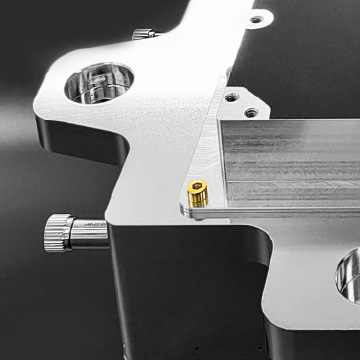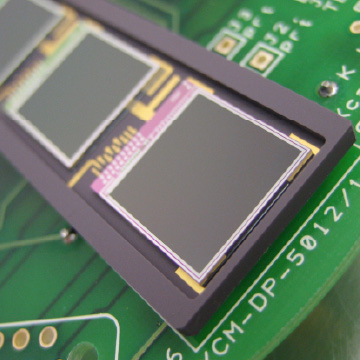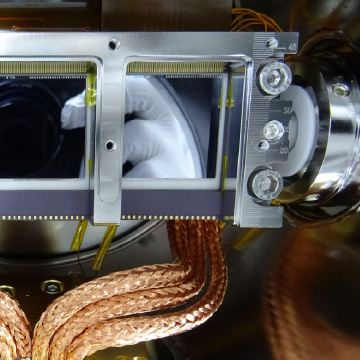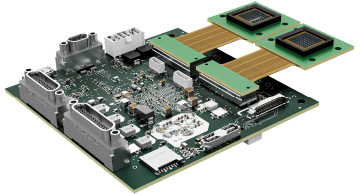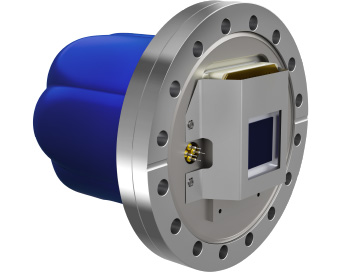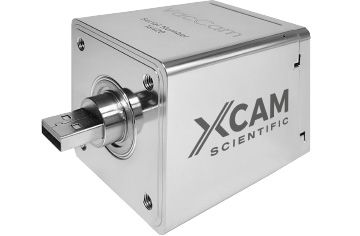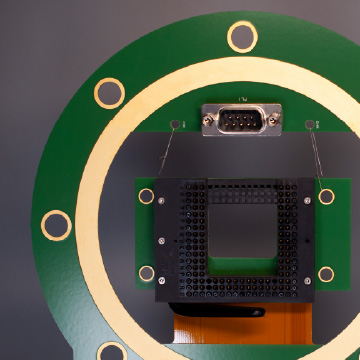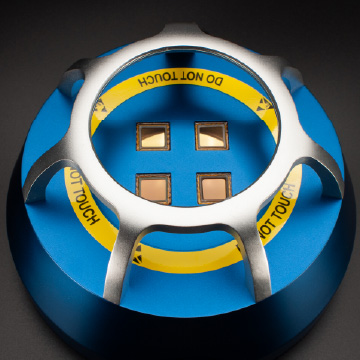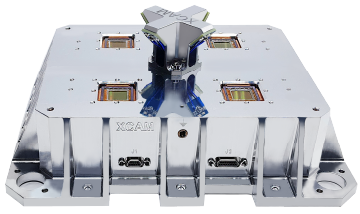



XCAM engineers will be at the 2017 NASA Contamination, Coatings, Materials, and Planetary Protection Workshop at NASA Goddard Space Flight Center in Maryland, USA this week to jointly present the latest developments of the PFO Particulate Fall-Out Monitor, alongside representatives from the European Space Agency (ESA). The workshop is a multi-disciplinary event attended by industry and academic professionals focussed on fostering successful space missions.
The original prototype PFO Monitor development was an ESA funded project which XCAM successfully bid and won the contract for. The PFO Monitor provides a remote, automated, real-time method of detecting particulate contamination. Initially intended for use within the fairing of rockets to measure particulate fall-out produced by vibrations during launch into space, further research and development has also focussed on producing a terrestrial-based version for use in commercial cleanrooms, to replace traditional methods such as witness plates which tend to be retrospective in nature and require human intervention. This novel use of silicon sensing technology allows particulates to be detected to below the five-micron level, providing an effective contamination control method for surface particulates.
Go to the PFO 1000 Particulate Fall-Out Monitor product page for more information
The winners of the Insider Made in the Midlands Awards 2017 were announced at an awards ceremony in Birmingham last night; XCAM are delighted to have been selected as the winner for the Advanced Engineering/Technology category for a second, consecutive year, based on their innovative C3D CubeSat camera system which has been successfully demonstrated in space.
The winners and shortlists from each category can be viewed on the Insider website, which describes XCAM as a business which “relishes the challenge of the technically difficult and making it work” and whose “new generation of cameras for outer space shows a company taking Midlands’ ingenuity to the final frontier.”
XCAM’s success in the regional awards means they will automatically be shortlisted for the national Insider Made in the UK Awards 2017, the winners of which will be announced at a second awards ceremony in Liverpool on Thursday 22nd June.
A cold atom cloud suspended in a magneto optical trap (MOT) has been successfully imaged by XCAM’s C3D CubeSat camera system. The captured image shows the cold atom cloud as the bright spot at the centre of the image, produced using the University of Birmingham’s miniature MOT system, with XCAM engineers working alongside a team from the UK National Quantum Technology Hub in Sensors and Metrology. The cold atom cloud is formed from rubidium atoms held within a vacuum chamber using a combination of lasers and magnetic fields to cool and trap the atoms. This represents an initial milestone for collaborators of the Cold Atom Space Payload (CASPA) project, led by Teledyne e2v, which aims to reduce the size, weight and power of such a system such that it is compatible as a 6U CubeSat payload.
For more information read our previous post about the CASPA project.
(Image courtesy of University of Birmingham)
XCAM attended the Science Day held by Northampton High School, a local school for girls, in support of the opening of their brand new junior science lab. CEO of XCAM, Karen Holland, was invited to ‘cut the ribbon’ which included igniting a container full of flammable gas, much to the excitement of the audience. Other events throughout the day included fun science demonstrations from Atomic Tom, rocket launches and an on-site planetarium, to name a few.
The science lab has been constructed to engage the girls in science before they reach secondary school, to inspire them to uptake STEM related subjects at later stages of their academic career. Northampton High School actively encourages participation in STEM subjects amongst their students including offering STEM ambassador programmes to the senior students, who interviewed XCAM engineers as part of their work, and a recent trip to a conference for the junior students who were lucky enough to meet astronaut Tim Peake!
XCAM has been shortlisted for the 2017 ‘Insider Made in the Midlands’ award in the Advanced Manufacturing/Technology category. This represents the second year in a row that XCAM has been shortlisted for the award, which XCAM won in 2016.
The award is offered for the use of technology or technical processes to solve a problem or add value to customers, and is given to companies deemed by the judges to be forward-looking and investing in advanced manufacturing processes, techniques and equipment. In this instance, XCAM has been shortlisted for the development of its C3D CubeSat imager technology, which has been proven in space.
The full shortlist for the award, along with shortlists for the other eight categories, is available at the Insider website. The winners will be announced at the Insider Made in the Midlands Awards Dinner in Birmingham on Thursday 18th May.
XCAM will be providing the electronics for the camera and experiment controller aboard the Cold Atom Space PAyload (CASPA); the third CubeSat project involving XCAM as a collaborator. Led by e2v with scientific expertise provided by University of Birmingham and University of Southampton, CASPA brings together a UK consortium of key industrial partners including Gooch & Housego, Clydespace, Covesion and XCAM to develop a CubeSat payload capable of producing cold atoms in space.
The CASPA project, supported by UK National Quantum Technologies (QT) and Innovate UK, aims at accelerating the commercialisation of quantum sensors for space markets. Cold atoms can be used as highly sensitive sensors with the ability to measure miniscule changes in Earth’s gravitation field; gravity mapping would allow movement of mass within the Earth to be finely monitored which would be beneficial to many applications such as flooding and natural disaster resilience.
Original images courtesy of Surrey Space Centre, University of Surrey (CubeSat model) and NASA (background image). Image adapted from originals for marketing purposes.
The first colour images taken with XCAM’s next generation C3D2 camera controller have been successfully captured and transmitted from space. C3D2 is one of three payloads aboard the AlSat Nano CubeSat; a joint nanosatellite mission between the Algerian Space Agency (ASAL) and the UK Space Agency (UKSA). The C3D2 camera suite development was led by the Open University (OU) in collaboration with XCAM and e2v; XCAM built the camera controller and electronics for the three CMOS sensors provided by e2v. These images represent the second successful space camera manufactured by XCAM, raising the TRL of its space electronics and providing access to space markets.
The images were taken above the Arkhangelsk Oblast region, on the North West coast of Russia on 3rd December 2016 at dawn. The coastline and winter sunrise are visible along with evidence of geological features such as snow-capped mountains and river valleys. The Oxford Space Systems Ltd AstroTube BoomTM payload is also visible in the image. (Image credit: AlSat Nano mission, Open University)
Read the UKSA press release or the OU press release, or watch a video simulation of the launch.
The National Synchrotron Radiation Research Centre (NSRRC) in Taiwan has just had their second XCAM CAVACam system shipped. The camera will be used to study x-ray interactions in the solid state. The system is the second to be used at the facility. The first was installed in 2014 and is used for their resonant inelastic x-ray scattering (RIXS) experiments. The CAVACam system can be a convenient solution where a vacuum-compatible camera is needed and can be used with a variety of different sensor models.
XCAM was invited to attend the Vacuum Ultraviolet and X-ray conference at ETH in Zurich to present a poster on the development of the RIXSCam system, one of which was recently commissioned on the ADRESS beamline at the Swiss Light Source. The biannual conference is the third successive conference following a merger of two long-standing conference series. Major topics of interest at the conference were resonant inelastic x-ray scattering (RIXS) and angle-resolved photoemission spectroscopy (ARPES). The XCAM poster summarised the key features of the RIXSCam and early results and can be read here (link to the literature page). It was exciting to see a range of experiments aimed at developing our understanding of the electronic structure of various materials.
XCAM has been named the winner of the Made in the Midlands 2016, run by Insider Midlands magazine. The award was in the Advanced Manufacture / Technology category, where XCAM’s camera systems were judged to be outstanding among the competition. Details of the judges’ comments for XCAM, as well as the winners in other categories, can be found in the link below.
http://www.insidermedia.com/galleries/made-in-the-midlands-awards-2016/i…

XCAM Scientific
2 Stone Circle Road
Round Spinney Industrial Estate
Northampton, NN3 8RF, UK