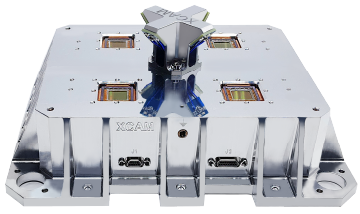



XCAM has been shortlisted for the 2017 ‘Insider Made in the Midlands’ award in the Advanced Manufacturing/Technology category. This represents the second year in a row that XCAM has been shortlisted for the award, which XCAM won in 2016.
The award is offered for the use of technology or technical processes to solve a problem or add value to customers, and is given to companies deemed by the judges to be forward-looking and investing in advanced manufacturing processes, techniques and equipment. In this instance, XCAM has been shortlisted for the development of its C3D CubeSat imager technology, which has been proven in space.
The full shortlist for the award, along with shortlists for the other eight categories, is available at the Insider website. The winners will be announced at the Insider Made in the Midlands Awards Dinner in Birmingham on Thursday 18th May.
XCAM will be providing the electronics for the camera and experiment controller aboard the Cold Atom Space PAyload (CASPA); the third CubeSat project involving XCAM as a collaborator. Led by e2v with scientific expertise provided by University of Birmingham and University of Southampton, CASPA brings together a UK consortium of key industrial partners including Gooch & Housego, Clydespace, Covesion and XCAM to develop a CubeSat payload capable of producing cold atoms in space.
The CASPA project, supported by UK National Quantum Technologies (QT) and Innovate UK, aims at accelerating the commercialisation of quantum sensors for space markets. Cold atoms can be used as highly sensitive sensors with the ability to measure miniscule changes in Earth’s gravitation field; gravity mapping would allow movement of mass within the Earth to be finely monitored which would be beneficial to many applications such as flooding and natural disaster resilience.
Original images courtesy of Surrey Space Centre, University of Surrey (CubeSat model) and NASA (background image). Image adapted from originals for marketing purposes.
The first colour images taken with XCAM’s next generation C3D2 camera controller have been successfully captured and transmitted from space. C3D2 is one of three payloads aboard the AlSat Nano CubeSat; a joint nanosatellite mission between the Algerian Space Agency (ASAL) and the UK Space Agency (UKSA). The C3D2 camera suite development was led by the Open University (OU) in collaboration with XCAM and e2v; XCAM built the camera controller and electronics for the three CMOS sensors provided by e2v. These images represent the second successful space camera manufactured by XCAM, raising the TRL of its space electronics and providing access to space markets.
The images were taken above the Arkhangelsk Oblast region, on the North West coast of Russia on 3rd December 2016 at dawn. The coastline and winter sunrise are visible along with evidence of geological features such as snow-capped mountains and river valleys. The Oxford Space Systems Ltd AstroTube BoomTM payload is also visible in the image. (Image credit: AlSat Nano mission, Open University)
Read the UKSA press release or the OU press release, or watch a video simulation of the launch.
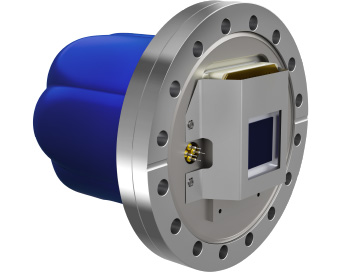
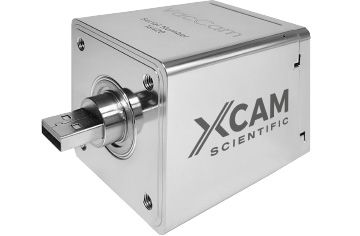
The National Synchrotron Radiation Research Centre (NSRRC) in Taiwan has just had their second XCAM CAVACam system shipped. The camera will be used to study x-ray interactions in the solid state. The system is the second to be used at the facility. The first was installed in 2014 and is used for their resonant inelastic x-ray scattering (RIXS) experiments. The CAVACam system can be a convenient solution where a vacuum-compatible camera is needed and can be used with a variety of different sensor models.
XCAM was invited to attend the Vacuum Ultraviolet and X-ray conference at ETH in Zurich to present a poster on the development of the RIXSCam system, one of which was recently commissioned on the ADRESS beamline at the Swiss Light Source. The biannual conference is the third successive conference following a merger of two long-standing conference series. Major topics of interest at the conference were resonant inelastic x-ray scattering (RIXS) and angle-resolved photoemission spectroscopy (ARPES). The XCAM poster summarised the key features of the RIXSCam and early results and can be read here (link to the literature page). It was exciting to see a range of experiments aimed at developing our understanding of the electronic structure of various materials.
XCAM has been named the winner of the Made in the Midlands 2016, run by Insider Midlands magazine. The award was in the Advanced Manufacture / Technology category, where XCAM’s camera systems were judged to be outstanding among the competition. Details of the judges’ comments for XCAM, as well as the winners in other categories, can be found in the link below.
http://www.insidermedia.com/galleries/made-in-the-midlands-awards-2016/i…
XCAM has been shortlisted for the ‘Insider Made in the Midlands’ 2016 award, in the advanced manufacture section, as a result of its development of a new camera system for high-end scientific applications. The RIXSCam™ has been developed in consultation with the researchers at one of the world’s leading science facilities, the Swiss Light Source and scientists at the Open University. The scientists who will use the camera system to study the structure of novel materials through their interactions with x-rays.
The project is another example of XCAM’s success in collaborative design to meet the demanding requirements of our customers and builds on our tradition of working with scientists to develop new solutions for challenging conditions. In addition to the growth of experience in the field, a new graduate has been taken on to complete an industrial PhD programme, which will be completed through studies undertaken at the Open University in the UK.
Drs Thorsten Schmitt and Bernd Schmitt from the Paul Scherrer Institute (PSI) have visited XCAM to witness testing of the new RIXSCam™ system. The system was developed by XCAM in consultation with the researchers to provide a tailor-made system for science on RIXS beamlines. The RIXSCam™ will be used in the world’s most advanced synchrotron light sources to investigate the electronic behaviour in condensed matter systems. The first system will be delivered to the PSI and commissioned at the ADRESS beamline of the Swiss Light Source in late spring this year.
The system is part of a wider series of advances to improve the resolution that can be achieved at RIXS beamlines. The RIXSCam™ design combines XCAM’s experience building for ultra-high vacuum conditions with post-processing of the captured image to achieve the highest sensitivity and resolution. The project is another example of XCAM’s success in collaborative design to meet the demanding requirements of our customers and builds on our tradition of working with scientists to develop new solutions for challenging conditions.
Established in 1995 as a spin-out of the space research centre at Leicester University, we initially focussed on developing control systems for CCD detectors. In 2003, we started to take on work designing and making complete camera systems in response to enquiries for systems that no one else was able to make. We now build detectors to be incorporated into larger systems and for a range of other applications.
XCAM’s reputation for innovation has been built up through working closely with our customers on their challenges, and on our extensive knowledge of detector science. We typically consult on specific applications of CCD technology with our customers and use our experience to design and build the complete system, including the electronics and the mechanical housing for the detector.
Continuously growing our team and capabilities, we never stop learning through our projects. If you have an unusual imaging or detection problem, why not talk to us about it today?
XCAM camera electronics has recently been launched into space on the UK Space Agency’s first Cube Satellite.
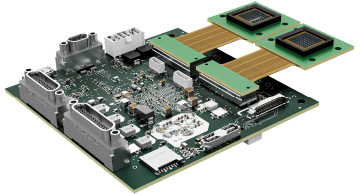
The camera, called C3D, was led by the Centre for Electronic Imaging (CEI) at the Open University. C3D houses three new CMOS sensors from e2v technologies into a design which will both take pictures of the earth and enable investigations of the impact of space radiation damage on the detectors. XCAM was responsible for the development and manufacture of the camera control electronics which uses state-of-the-art components, including a powerful FPGA to both control the CMOS sensors and to communicate with the main spacecraft computer.
Related news stories can be found below:
OU joins the Cubesat revolution
UK Space Agency announces successful launch for first cubesat mission

XCAM Scientific
2 Stone Circle Road
Round Spinney Industrial Estate
Northampton, NN3 8RF, UK