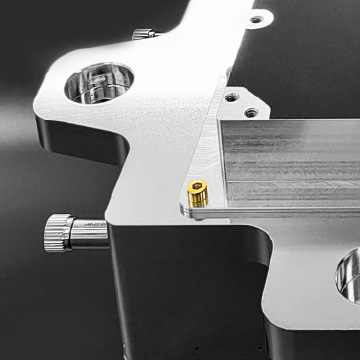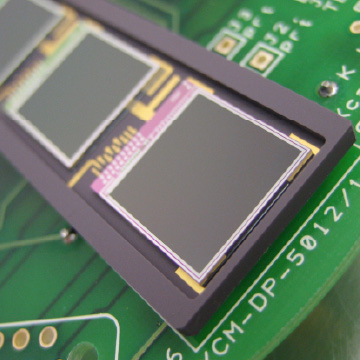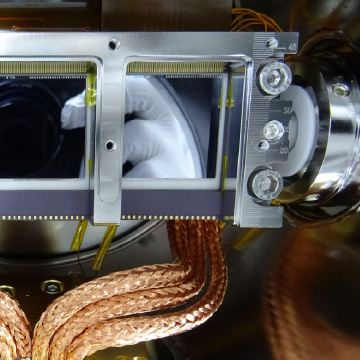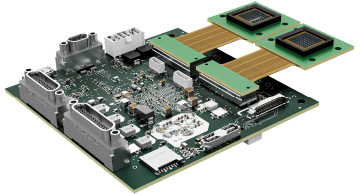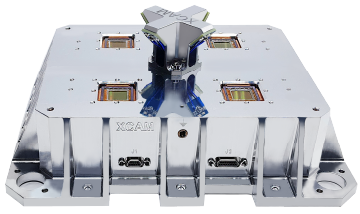



UK based XCAM Ltd, leaders in specialist digital camera systems, has delivered an advanced digital camera to Pennsylvania State University (PSU) in the USA, as part of a multi-million-dollar NASA space technology project that will see the system launched into space on a sub-orbital sounding rocket as part of the OGRE mission in 2025.
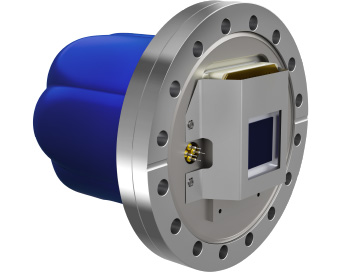
The Off-Plane Grating Rocket Experiment (OGRE) aims to increase the technology readiness levels for future space missions of a soft X-ray spectrometer made up of three new space technologies which have not flown in space before. One of these is the Electron Multiplying CCD camera designed and built by XCAM to capture X-ray photons from the target object; the Capella star system. The other two components include a unique Silicon Grazing Incidence X-ray Mirror, being developed at NASA’s Goddard Space Flight Center and Off-Plane Reflection Gratings using X-ray Diffraction being developed at PSU.
Karen Holland, CEO of XCAM Ltd, explained, “Our specialist digital cameras have a worldwide reputation for excellence. We are excited and pleased to have been chosen by Pennsylvania State University and to be working alongside NASA as part of this new advanced space technology demonstration mission.”
The OGRE mission consists of a 12.2 meter NASA Black Brant IX sounding rocket that will carry the three components on a suborbital trajectory into space for about 10 minutes before returning to Earth. During its time in space, it will collect approximately 500 X-ray photons from the Capella star system. The resulting data will be compared with X-ray data from the same star system captured by existing space-based X-ray spectrometers (e.g. NASA’s Chandra observatory). Comparing the data from these different instrument should demonstrate the readiness of these three new technologies for use in future flagship space missions to perform astronomical X-ray measurements.
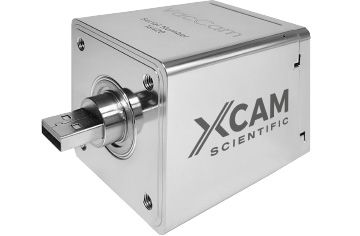
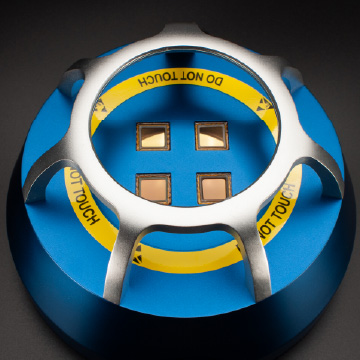
The EMCCD digital camera system from XCAM was developed in the UK and the OGRE flight will be the first time it will be used in space. The camera system consists of four Teledyne e2v Electron Multiplying CCDs that are able to greatly amplify the signal in each pixel before the pixels are read out (thus increasing the signal-to-noise ratio). The camera will be open to the vacuum of space and cooled to -100ᵒC during flight, and the captured X-ray photon data will be downloaded in real time.
James Tutt, Assistant Research Professor at Pennsylvania State University, commented, “We build a large number of X-ray spectrometers for use on sub-orbital rocket flights. Often we build the majority of the instrument ourselves, but sometimes we collaborate with other institutions or use companies to develop parts of the instrument. Working with XCAM, even though they are a company, has felt more like a collaboration. They have been flexible in working with us through many changes in the camera design, have kept us informed every step of the way in the progress of the camera build (even through a global pandemic), and have delivered the camera system on time.
We never had any concerns with using XCAM as our camera provider due to their excellent reputation in developing complex digital cameras systems for space technology and due to our previous experience working with them on the development of a CCD-based X-ray spectrometry camera.”
XCAM designs and manufactures highly specialized complex digital camera systems for challenging scientific, environmental and space applications. They are one of only a few companies in the world to offer complete imaging sensor camera solutions. XCAM have a worldwide reputation for their ability, reputation, expertise, and outstanding knowledge in the field.
Find out more here: OGRECam
UK based XCAM Ltd, leaders in specialist digital camera systems, has unveiled its next generation of low cost space imaging products as it seeks to support the needs of the growing global space sector. Nuscis is a range of compact SmallSat and CubeSat-compatible space imager products offering un-paralleled flexibility in space imaging systems design.
Karen Holland, CEO of XCAM Ltd, explained, “The design ethos behind XCAM Nuscis was to create a modular architecture that enables the widest possible range of applications at a low price point, drawn from many years developing leading-edge imaging systems for space, science and industrial applications. Supporting many different sensor-types means Nuscis can be easily customised to support a whole range of different SmallSat and CubeSat imaging applications including Earth observation, remote sensing, space situational awareness, rendezvous and docking and in-orbit servicing. This makes Nuscis the most versatile space imaging product on the market today.”
At the heart of Nuscis is the Imager Controller Board (ICB) which is itself a complete single-board imaging solution. Supporting several different families of TRL8/9 CMOS imaging sensors, the ICB can operate up to two CMOS sensors in a low-profile PC104 1/4U format and low <5W power footprint. The ICB has on-board data processing capability whilst telemetry, telecommanding and data transfer are handled through various common data interfaces. The ICB can be supplemented with auxiliary daughterboard and headboard solutions to enable operation of larger and mosre specialised CMOS, CCD or EM-CCD sensors with temperature control if required.
Nuscis development is on-going with Engineering Models (EM) available Q1 2024 and Flight Models (FM) available Q3 2024. Nuscis is available for pre-order now so contact us today to find out if Nuscis is suitable for your space imaging application.
Nuscis replaces XCAM’s C3D Cubesat Camera which has successfully flown on multiple space missions in the last decade. C3D remains available to purchase on a last-time-buy whilst-stocks-last basis so contact us today for a great deal on this space-qualified entry-level camera system.
XCAM Ltd, based in Northampton, has been named SME Business Innovation 2020/21 Silver Award winner at the prestigious SME National Business Awards in a field of 15 other finalists, in recognition of its outstanding contribution and innovation in the field of digital imaging systems.
Karen Holland, CEO of XCAM said “We are delighted to have won this Innovation Silver Award having been finalists last year, it provides recognition of the challenging work the whole team have put in over the last few years and the innovations we are developing being recognised as truly ground-breaking, unique and making a positive difference.”
Karen continued “We have been experiencing significant growth in sales from around the world, with our busiest year ever, including projects with the European Space Agency (ESA); the work associated with the delivery of a system for the Roman Space Telescope/NASA project in partnership with the Open University; winning a Space Research and Innovation Network for Technology (SPRINT) grant to work with the University of Leicester on the development of Convolutional Neural Network for a space project; and delivery of a new system to the Institute for Solid State Physics, University of Tokyo; plus many new high-profile orders. Our success is based on our worldwide reputation and outstanding knowledge, including the ability to solve complex problems.”
XCAM designs and manufactures highly specialized custom and low-volume complex digital camera systems for challenging scientific, environmental and space applications and recently celebrated 25 years in business. They are one of only a few companies in the world to offer complete imaging sensor camera solutions.XCAM have a worldwide reputation for their ability, reputation, expertise, and outstanding knowledge in the field.
Thanks to significant UK Government funding for innovation in space technology, XCAM Ltd working with the Open University, developed new enhanced performance imaging technology to help enable the Open University conduct research support as part of NASA’s Roman Space Telescope (Roman Space Telescope/NASA) and as a flagship for space applications in the future.
The XCAM specialist digital cameras have a worldwide reputation for excellence and will provide, as part of the wider team, light sensor, custom video camera systems using EMCCD technology (Electron Multiplying Charge-coupled Device) to help scientists monitor sensors and enhance performance for the next NASA suborbital rocket space mission and future missions.
“We were approached by the Open University, due to our experience and knowledge in developing highly complex digital camera systems using the EMCCD technology,” explained Karen Holland, CEO of XCAM Ltd, “Our system was the ideal fit to help the research objectives of the project, we increased the speed of some of our existing drive electronics and developed a new flexible sensor controller system. Detector scientists can now change almost any operating parameter when driving a detector and will make it particularly useful for characterisation of this new sensor technology for the NASA mission.”
XCAM designs and manufactures highly specialized custom and low-volume complex digital camera systems for challenging scientific, environmental and space applications. They are one of only a few companies in the world to offer complete imaging sensor camera solutions. XCAM have a worldwide reputation for their ability, reputation, expertise, and outstanding knowledge in the field.
Through the UK Space Agency, Government is giving a cash injection to five projects specifically designed to bring together UK business expertise with universities to help build space solutions to global problems, on UK soil.
The University of Leicester is to receive research funding to support XCAM for one of the projects, to improve the performance of cleanliness-monitoring equipment for use in the space industry. This is important because equipment, which is designed to be launched into space, needs to be super-clean. If it is not clean, then contamination can move to other delicate instruments like telescope optical surfaces, dulling them, or in the case of planetary missions, can contaminate pristine environments.
“We are delighted to be supported by the national Space Research and Innovation Network for Technology (SPRINT) and working with the University of Leicester Convolutional Neural Network experts,” explained Karen Holland, CEO of XCAM Ltd, “The University of Leicester scientists will be seeing if they can apply their expertise in novel machine learning solutions, to improve the accuracy of our cleanroom monitoring instrumentation.”
This project could form the basis of a next-generation instrument which should make cleanroom contamination monitoring even more precise, and enable the development of instruments that can operate in space for much longer than just the initial launch phases. At the same time, XCAM’s skills in neural network development will be enhanced.
The other four projects receiving a cash injection include: Using AI to automatically detect archaeology on Earth and provide data for planning permissions; Developing an Absolar carbon Action Planning Tool to monitor building’s current energy performance; Developing analytics to track the carbon and pollution emissions of ships; Developing a land-use classification map of key agricultural production in Malawi.
Science Minister Amanda Solloway said: “The UK’s space sector is flourishing, and it is vital we give our most innovative space businesses and universities the right support to collaborate, share best practice and drive forward new ideas that could help enrich all our lives.
“Today’s funding will provide lift-off to some of the country’s most ambitious space collaborations, accelerating potentially game-changing technologies that will help the UK respond to global challenges such as cutting carbon emissions.”
UK based, XCAM Ltd, designers and manufacturers of specialised digital imaging systems, has successfully completed its first order to Japan for the high-performance RIXSCam Mini, a new singledetector camera system, for use on the latest X-ray beamlines for resonant inelastic X-ray scattering (RIXS) experiments.
The order, from Professor Harada and Dr Miyawaki at the Institute for Solid State Physics, University of Tokyo, was delivered in December 2020 and overseen by XCAM’s distributor in Japan, JEPICO Corporation. Harada-san said, “By calculation this system will dramatically improve the energy resolution of our current RIXS spectrometer. We intend to make this trial as a test piece of the ultrahigh resolution RIXS system, designed by Dr Miyawaki and realized in the next generation synchrotron radiation in the near future.”
XCAM Ltd are confident no other high-performance camera in the world currently delivers results for this specific regime and type of testing, to detect single photons of soft X-rays, to less than to 5 microns positional resolution. This innovative RIXSCam Mini system is designed and built in the UK for scientists who have, or who are, building RIXS beamlines with synchrotrons for the future and is a lower cost version of the larger and more complex multi-detector RIXSCam, which has been developed for high-resolution RIXS experiments in conjunction with the Paul Scherre institute in Switzerland.
Karen Holland, CEO of XCAM explained further about the order, “When Harada-san first contacted us about our larger RIXSCam systems, he was impressed with the capabilities; however, he had a similar application which required the same outstanding performance as the traditional multidetector RIXSCam provides, but with a lower cost. We suggested that the RIXSCam Mini would offer the perfect solution. Whilst this was the first RIXSCam Mini system to be delivered, it uses most of the parts developed for the now mature, and more complex larger RIXSCam systems, and so the development was more straightforward than for many of our complex projects. We are delighted to be supplying Harada-san and the prestigious University of Tokyo and look forward to a long and prosperous partnership in the future.”
XCAM Ltd is advertising at next year’s Japanese Synchrotron Conference in January for synchrotron scientists and those who build and maintain synchrotrons. If you are a beamline scientist, or work with synchrotrons, and interested in purchasing high-performance cameras to put on beamlines, please contact us on +44 (0)1604 673700 or email sales@xcam.co.uk for more information.
XCAM Ltd, celebrating 25 years in business, is currently experiencing significant growth in sales from around the world, with its busiest year ever, including new contracts with the European Space Agency (ESA) and several highly prestigious innovation award nominations. The success is based on its worldwide reputation and outstanding knowledge in the field of digital imaging systems, including the ability to solve complex problems.
XCAM Ltd, based in Northampton, designers and manufacturers of specialized digital imaging systems, has joined a consortium of leading UK industry and academic partners, led by The Open University, to undertake a scoping study which will push the limits of leading CMOS TDI sensors and optimise system configuration to develop a new satellite platform for the classification, characterisation and monitoring of trees across urban and rural landscapes. The results from this study will inform and support a bid for full funding of the project.
Funded by the UK Space Agency, the study for the project, called TreeView, will transform the ability to measure, map and monitor the health of trees from space. The UK is leading the way in response to the global climate emergency, with a commitment for net-zero carbon emissions by 2050. A programme of significant tree planting for carbon sequestration and storage is planned by the UK government as part of this response, and applications in the emerging field of Precision Forestry such as TreeView will be crucial to the success of these initiatives. The satellite’s goal, if successful, will be to provide information on the level of tree planting, and the health and management of trees across urban and rural landscapes, providing vital data to governments, industry and third sector organisations.
Karen Holland, CEO of XCAM explained further, “We are delighted to be part of this scoping study over the next four months and look forward to hopefully designing and building the complex imager required, should the project succeed to the next stage of funding. In this first feasibility stage, we will be evaluating the imager system requirements and available technology, develop a suitable imager design concept and cost up towards building the imager, and preparing it for integration and subsequent launch.
XCAM Ltd, celebrating 25 years in business, is currently experiencing significant growth in sales from around the world, with its busiest year ever, including new contracts with the European Space Agency (ESA) and several highly prestigious innovation award nominations. The success is based on its worldwide reputation and outstanding knowledge in the field of digital imaging systems, including the ability to solve complex problems.
TreeView is led by Kadmiel Maseyk from the School of Environment Earth and Ecosystems and involves the Next Generation Multi-Media Group from Computing and Communications, and the Centre for Electronic Imaging. The external partners are XCAM Ltd, In-Space Missions Ltd, RAL Space, Teledyne e2v, Forest Research, the Centre for Ecology and Hydrology, Grey Consultants Ltd and 2Excel-geo.
http://www.open.ac.uk/research/news/new-research-funding-measure-trees-space
Following successful trials of a prototype sensor, space-tech company XCAM is working with ESA to develop a flight-ready device that monitors dust contamination on payloads during and shortly after launch.
The device will provide data to demonstrate whether or not precious cargos – such as Earth-observing satellites – stay clean on their way into space.
Payloads are protected from the elements within a secure capsule in the upper part of launcher called the fairing. Once outside the Earth’s atmosphere, the fairing separates, exposing its contents to space.
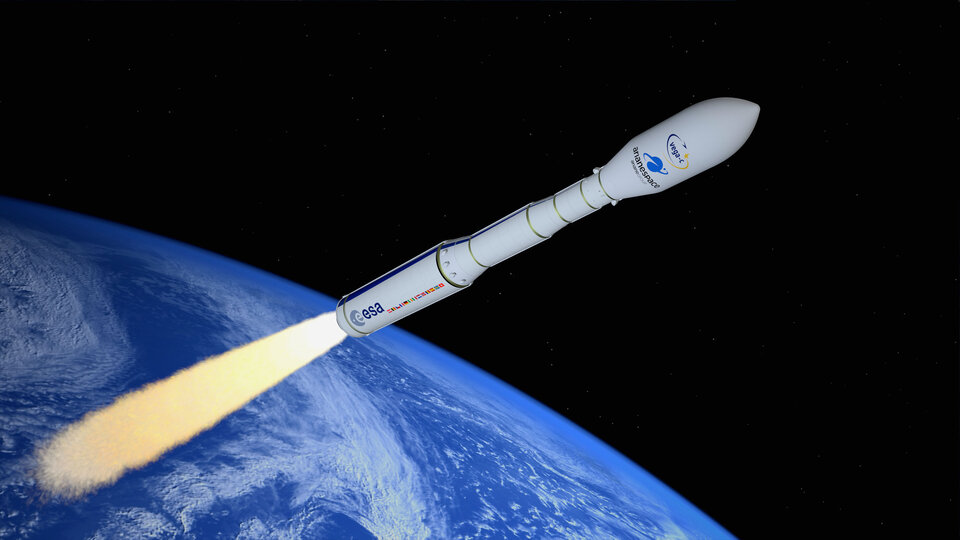
Cleanrooms protect spaceborne equipment from contamination during assembly, but vibrations and shocks during launch may shake up residues in the fairing that can affect how the payload operates.
Dust particles can contaminate optical surfaces, such as those found on Earth-observing satellites, as well as affecting the performance of sensitive mechanical equipment.
XCAM’s sensor keeps track of contamination remotely to provide continuous measurements in real-time.
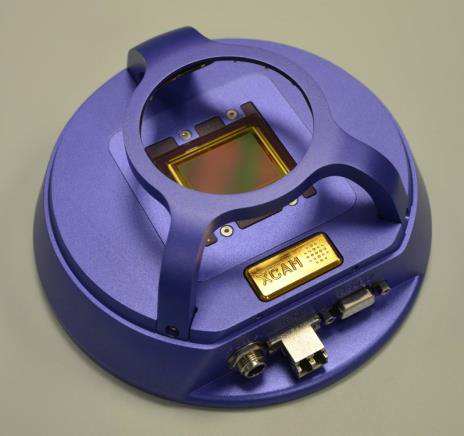
The company is now working with ESA to develop a device that will be used in the fairing of the European Vega-C launcher. The gadget must be able to withstand the mechanical loads of launch such as acoustics and vibrations – and then survive in space for long enough to relay data back to Earth for analysis.
It will enable satellite launchers to provide evidence to their customers that payloads are kept spotless on their way into orbit.
“It was fantastic for XCAM to work on such an exciting project with ESA at the prototype stage, but to have been able to go beyond that, and win the contract to develop the flight qualified system is even better,” says Karen Holland, chief executive of XCAM.
“Following these achievements, XCAM has recently received several highly prestigious awards nominations for our work in the field of digital imaging systems. As a very small company of just 15 people, we are very pleased to be recognised by the awards judges.”
“Because of the very peculiar contamination mechanisms it presents, and the lack of monitoring inside the fairing, the launch phase is somewhat of an unresolved question for contamination engineers – which makes control of particulate very challenging,” says Riccardo Rampini, technical officer for the XCAM project.
“With the development of a novel sensor capable of operating before and during launch, which will provide real-time information on the particulate inside the fairing of a launcher, ESA will soon provide a solution to this problem.”
See the full ESA press release covering the item.
Northampton based XCAM, is celebrating 25 years in business with several highly prestigious innovation award nominations. The company, designers and manufacturers of specialized digital imaging systems for challenging scientific, environmental and space applications, has also seen a significant growth in sales, including new contracts with the European Space Agency (ESA).
XCAM are finalists in the National SME Business Awards 2020 for the Business Innovation Award category. Shortlisted for the Northampton SME Business Awards 2020 in the Business Innovation Award category and shortlisted for the 2020 Manufacturing Innovation Award for its space cameras at the Business Insider Made in the Midlands Awards (XCAM won this award in 2017).
Karen Holland, CEO of XCAM is delighted by the outstanding achievements “I am really proud of the whole team, for all the hard work and the dedication they have contributed. Who would have thought 25 years ago, setting up the business in our spare room at home, that now we would be in a 7,000 sq. ft building with two clean rooms, have 15 staff and approaching 1.5 million turnover all through organic growth.”
The company’s significant growth in sales and busiest year ever, has been based on its worldwide reputation and outstanding knowledge in the field of digital imaging systems, including the ability to solve complex problems.
Some years ago the ESA, decided that they were not satisfied with existing technologies for Particle Fall-Out (PFO) monitoring and they wanted to develop a new instrument that could measure contamination all the time, remotely, and without human intervention to give continuous measurements. XCAM won the competitive tender to develop a novel prototype instrument which was delivered in 2017. This provided the background to the achievements of the last 12 months.
In January, XCAM signed a new follow-on contract with the ESA to start development of flight-qualified units over the next 2 years. This will involve them developing a unit which is not only suitable for surviving the unfriendly launch conditions which the Arianespace Vega launcher will subject the unit to, but which can also survive in space for long enough to send the launch data back down to the earth for later analysis. The new instrument, will measure particulate fall-out inside the rocket environment during a real rocket launch and provide ESA with critical information about the launch environment which their payloads experience – information which ESA has never previously had access to.
Rocket launchers currently have no way of providing evidence to their customers that they keep the customers’ payloads clean during and shortly after launch, despite charging large sums to launch their payloads. The potential for XCAM to ultimately sell flight-qualified units, for launchers to prove their environments is huge.
Medilink press release covering the item.
A bespoke headboard, designed by XCAM to drive a custom CCD image sensor for the Ultraviolet Visible Near-infrared (UVN) instrument aboard the European Space Agency’s Sentinel-4 satellite mission has been successfully delivered to ESA. The mission aims to monitor trace gas concentrations and aerosols in the atmosphere from a geostationary orbit above Europe, in order to support the provision of real-time air quality and climate monitoring as part of the European Commission (EC) and ESA’s Earth Observation Programme, Copernicus.
Following intial discussions between XCAM and ESA to understand the scope of the work, a proposal was generated outlining the specifications and work to be undertaken by XCAM for successful delivery of the headboard.
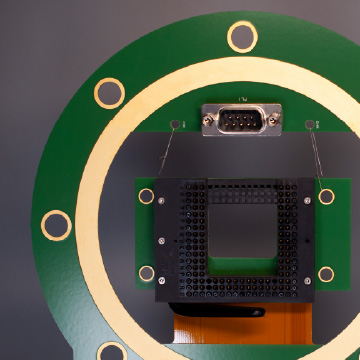
The work which was carried out began with XCAM designing, in conjunction with ESA, the mechanical format of the headboard, the technical specification and requirements of the headboard, and the associated cables required to interface to the cryogenically-cooled test chamber and the Archon controller which was to be used. Next XCAM drew up the headboard circuit schematic, and after approval from ESA, designed the printed circuit board layout for the headboard. After manufacture of the headboard and all cables, XCAM used a grade 5 detector, loaned by ESA, to design the sequencer program which operated the clocks of the detector, and to test that all aspects of the system were fully working. The system, once fully tested, was delivered to ESA with a test report detailing operation of the system.
The delivery of the Sentinel-4 headboard represents a continuation in the design and supply of bespoke image sensor headboards for space applications by XCAM, following previous successes such as headboard design for ESA’s Euclid mission. Contact XCAM today to discuss how we may be able assist with your CCD- and CMOS-based imaging solutions.

XCAM Scientific
2 Stone Circle Road
Round Spinney Industrial Estate
Northampton, NN3 8RF, UK